Monday, October 15, 2018

Week of October 15, 2018


Astronomy


What Is a Black Hole?

cygx1_ill.jpg
An artist's drawing a black hole named Cygnus X-1. It formed when a large star caved in. This black hole pulls matter from blue star beside it.
Credits: NASA/CXC/M.Weiss
blackhole_2.jpg
An artist's drawing shows the current view of the Milky Way galaxy. Scientific evidence shows that in the middle of the Milky Way is a supermassive black hole.
Credits: NASA/JPL-Caltech
Black hole Sagittarius A
This image of the center of the Milky Way galaxy was taken by the Chandra X-ray Observatory.
Credits: NASA/CXC/MIT/F.K. Baganoff et al.
sgr_lg.jpg
Sagittarius A* is the black hole at the center of the Milky Way galaxy.
Credits: X-ray: NASA/UMass/D.Wang et al., IR: NASA/STScI
This article is part of the NASA Knows! (Grades K-4) series.
 
A black hole is a place in space where gravity pulls so much that even light can not get out. The gravity is so strong because matter has been squeezed into a tiny space. This can happen when a star is dying.
Because no light can get out, people can't see black holes. They are invisible. Space telescopes with special tools can help find black holes. The special tools can see how stars that are very close to black holes act differently than other stars.

How Big Are Black Holes?
Black holes can be big or small. Scientists think the smallest black holes are as small as just one atom. These black holes are very tiny but have the mass of a large mountain. Mass is the amount of matter, or "stuff," in an object.
Another kind of black hole is called "stellar." Its mass can be up to 20 times more than the mass of the sun. There may be many, many stellar mass black holes in Earth's galaxy. Earth's galaxy is called the Milky Way.
The largest black holes are called "supermassive." These black holes have masses that are more than 1 million suns together. Scientists have found proof that every large galaxy contains a supermassive black hole at its center. The supermassive black hole at the center of the Milky Way galaxy is called Sagittarius A. It has a mass equal to about 4 million suns and would fit inside a very large ball that could hold a few million Earths.

How Do Black Holes Form?
Scientists think the smallest black holes formed when the universe began.
Stellar black holes are made when the center of a very big star falls in upon itself, or collapses. When this happens, it causes a supernova. A supernova is an exploding star that blasts part of the star into space.
Scientists think supermassive black holes were made at the same time as the galaxy they are in.

If Black Holes Are "Black," How Do Scientists Know They Are There?
A black hole can not be seen because strong gravity pulls all of the light into the middle of the black hole. But scientists can see how the strong gravity affects the stars and gas around the black hole. Scientists can study stars to find out if they are flying around, or orbiting, a black hole.
When a black hole and a star are close together, high-energy light is made. This kind of light can not be seen with human eyes. Scientists use satellites and telescopes in space to see the high-energy light.

Could a Black Hole Destroy Earth?
Black holes do not go around in space eating stars, moons and planets. Earth will not fall into a black hole because no black hole is close enough to the solar system for Earth to do that.
Even if a black hole the same mass as the sun were to take the place of the sun, Earth still would not fall in. The black hole would have the same gravity as the sun. Earth and the other planets would orbit the black hole as they orbit the sun now.
The sun will never turn into a black hole. The sun is not a big enough star to make a black hole.

How Is NASA Studying Black Holes?
NASA is using satellites and telescopes that are traveling in space to learn more about black holes. These spacecraft help scientists answer questions about the universe.

Return to Students K-4
Heather R. Smith/NASA Educational Technology Services
Last Updated: Aug. 21, 2018

Editor: Flint Wild

https://www.nasa.gov/audience/forstudents/k-4/stories/nasa-knows/what-is-a-black-hole-k4.html


Foundations of Algebra

Solving Literal EquationsOne of the dictionary definitions of "literal" is "related to or being comprised of letters", and variables are sometimes referred to as literals. So "solving literal equations" seems to be another way of saying "taking an equation with lots of letters, and solving for one letter in particular."

At first glance, these exercises appear to be much worse than our usual solving exercises, but they really aren't that bad. We pretty much do what we've done all along for solving linear equations and other sorts of equation; the only substantial difference is that, due to all the variables, we won't be able to simplify our work as we go along, nor as much as we're used to at the end. Here's how solving literal equations works:
  • Solve A = bh for b

This is the formula for the area A of a rectangle with base b and height h. They're asking me to solve this formula for the base b.
If they'd asked me to solve 3 = 2b for b, I'd have divided both sides by 2 in order to isolate (that is, in order to get by itself, or solve for) the variable b. I'd end up with the variable b being equal to a fractional number.
In this case, I won't be able to get a simple numerical value for my answer, but I can proceed in the same way, using the same step for the same reason (namely, that it gets b by itself). So, following the same reasoning for solving this literal equation as I would have for the similar one-variable linear equation, I divide through by the "h":
\small{ A = bh }
\small{ \dfrac{A}{h} = \dfrac{bh}{h} }
\small{ \bm{\color{purple}{ \dfrac{A}{h} = b }}}
The only difference between solving the literal equation above and solving the linear equations you first learned about is that I divided through by a variable instead of a number (and then I couldn't simplify, because the fraction was in letters rather than in numbers). Because we can't simplify as we go (nor, probably, at the end), it can be very important not to try to do too much in one's head. Write everything out completely; this will help you end up with the correct answers.

  • Solve d = rt for r

This equation is the "uniform rate" equation, "(distance) equals (rate) times (time)", that is used in "distance" word problems, and solving this for the specified variable works just like solving the previous equation.
The variable they want has a letter multiplied on it; to isolate the variable, I have to divide off that letter. So I'll solve for the specified variable r by dividing through by the t:
\small{ d = rt }
\small{ \dfrac{d}{t} = \dfrac{rt}{t} }
\small{ \bm{\color{purple}{ \dfrac{d}{t} = r }}}

https://www.purplemath.com/modules/solvelit.htm

Monday, October 8, 2018

Week of October 8, 2018

Astronomy

Space Based Telescopes

Resources:  https://www.space.com/6716-major-space-telescopes.html  https://www.nasa.gov/index.html 
 https://jwst.nasa.gov/index.html  
https://www.cfa.harvard.edu/facilities/Space-Based-Telescopes 
 https://www.popularmechanics.com/space/telescopes/a12257/4299775/ 
 https://www.nasa.gov/audience/forstudents/postsecondary/features/F_NASA_Great_Observatories_PS.html

Foundations of Algebra

Solve equations with variables on both sides

1) Solve. 3x + 2 = 4x - 1
You need to get the variables on one side of the equation.  It does not matter which variable you move.  Try to move the one that will keep your variable positive.
Solve 3x + 2 = 4x - 1
1.Draw “the river”
2.Subtract 3x from both sides
3.Simplify
4.Add 1 to both sides
5.Simplify
6.Check your answer


3x + 2 = 4x - 1
- 3x         - 3x
          2  =  x - 1
       + 1        + 1
           3 = x

3(3) + 2 = 4(3) - 1
     9 + 2 = 12 - 1


Monday, October 1, 2018

Week of October 1,2018

Astronomy

- Complete Article review and KIM chart
- Study for vocab quiz


Foundations of Algebra

Solving One step Equations

  1. Solve 
Remember the goal is to have the variable by itself on one side of the equation. In this problem, that means moving the 5 to the other side of the equation. Since the 5 is added to the variable, we move it to the other side of the equation by subtracting 5. However, if we subtract 5 from the left side of the equation, we MUST also subtract 5 from the right side.

  1. Solve 
It does not matter that the variable in this equation is on the right side of the equation. The position of the variable is not an issue. Remember that the goal is to have the variable on one side by itself. It does not matter which side.

To get the variable by itself, we need to add 3 to both sides.

  1. Solve 
The variable in this equation is already on one side of the equation by itself. There is no need to add or subtract anything to both sides. However, the number in front of the variable is not 1. The -3 that is in front of the variable indicates multiplication of -3 by x. The opposite operation of multiplication is division. So we will divide both sides by -3.
You should take note of the different ways of writing the answer. In the example, we divided by -3, yet wrote the answer with the negative in front of the entire fraction, not just the 3. Each of the following fractions all mean the same thing.

  1. Solve 
The variable in this equation is already on one side by itself, but it is divided by 3. To get rid of the 3 that is attached to the variable by division, we will perform the opposite operation which is multiplication. Notice that our variable can be any letter. It does not always have to be x.

  1. Solve 
Once again, the variable is on one side by itself, but is multiplied by a -3 and divided by 5. Let’s take care of each operationseparately and see what happens. First we’ll get rid of the 5 by multiplying both sides by 5. Then we’ll get rid of the -3 by dividing both sides by -3.
Rather than perform two separate steps of multiplying by 5 and then dividing by -3, it is possible to combine those operations into one step. In other words, we can multiply both sides by . The value  is called the reciprocal of . The reciprocalof a number has the same sign, but the numerator and denominator are reversed. So what was on bottom, is now on top. And what was on top, is now on bottom.

If we re-work Example 5 by using the reciprocal, you can see that it will save a step in the solution process.

http://www.algebralab.org/lessons/lesson.aspx?file=algebra_onevariableonestep.xml


Monday, September 17, 2018

Week of September 19,2018

Astronomy

Properties of Light

Video Clip Hubble Decodes Colors of the Galaxy https://www.youtube.com/watch?v=qtkEDclukd4

Watch video Crash Course Light https://www.youtube.com/watch?v=jjy-eqWM38g

    • TED ED Light waves, visible and invisible
 https://www.youtube.com/watch?time_continue=25&v=O0PawPSdk28

§  ThougtCo. Article: What is Blackbody Radiation?” https://www.thoughtco.com/blackbody-radiation-2699349

·       https://www.brainpop.com/science/energy/electromagneticspectrum/

Foundations of Algebra

Slope
Here is a practice link for solving slope (word problems)
https://braingenie.ck12.org/skills/105411

Monday, September 10, 2018

Week of September 10,2018

Astronomy

Complete your study guide and Newton's law lab.

Foundation of Algebra

Coordinate graphing sounds very dramatic but it is actually just a visual method for showing relationships between numbers. The relationships are shown on a coordinate grid. A coordinate grid has two perpendicular lines, or axes, labeled like number lines. The horizontal axis is called the x-axis. The vertical axis is called the y-axis. The point where the x-axis and y-axis intersect is called the origin.

The numbers on a coordinate grid are used to locate points. Each point can be identified by an ordered pair of numbers; that is, a number on the x-axis called an x-coordinate, and a number on the y-axis called a y-coordinate. Ordered pairs are written in parentheses (x-coordinate, y-coordinate). The origin is located at (0,0). Note that there is no space after the comma.
The location of (2,5) is shown on the coordinate grid below. The x-coordinate is 2. The y-coordinate is 5. To locate (2,5), move 2 units to the right on the x-axis and 5 units up on the y-axis.

The order in which you write x- and y-coordinates in an ordered pair is very important. The x-coordinate always comes first, followed by the y-coordinate. As you can see in the coordinate grid below, the ordered pairs (3,4) and (4,3) refer to two different points!
https://www.eduplace.com/math/mathsteps/4/c/index.html


Wednesday, September 5, 2018

Week of September 4, 2018

Astronomy

Newton's Laws of Motion


The laws that govern motion eluded scientists, philosophers and other great thinkers until the 17th century. Then, in the 1680s, Isaac Newton proposed three laws that explained how inertia, acceleration and reaction influence the motion of objects. Along with Newton’s law of gravitation, these laws formed the basis of classical physics.

The Law of Inertia

Stones will remain at rest until a force causes them to move.
Newton's first law of motion, also known as the law of inertia, states that objects neither move nor cease to move on their own. An object only changes its state of motion when acted on by an outside force. A ball at rest, for example, will remain at rest until you push it. It will then roll until friction from the ground and the air brings it to a halt.

The Law of Acceleration

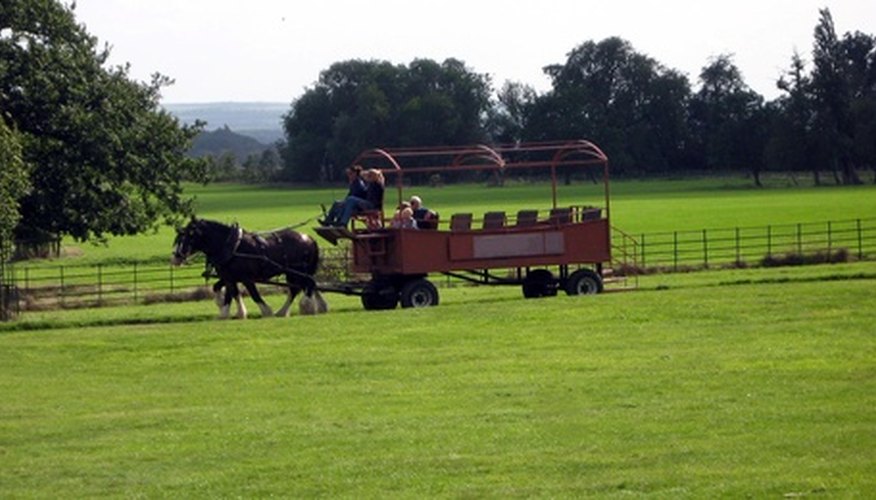
A horse accelerates the cart's movement. The cart's mass slows the horse.
Newton's second law explains how external forces affect the velocity of an object in motion. It states that acceleration of an object is directly proportional to the force that causes it, and inversely proportional to the object's mass. In practical terms, this means that it takes more force to move a heavy object than a light one.
Consider a horse and cart. The amount of force the horse can apply determines the cart's speed. The horse could move faster with a smaller, lighter cart in tow, but its maximum speed is limited by the weight of a heavier cart.
In physics, deceleration counts as acceleration. Thus, a force acting in the opposite direction of a moving object causes an acceleration in that direction. For example, if a horse is pulling a cart uphill, gravity pulls the cart downward as the horse pulls upward. In other words, the force of gravity causes a negative acceleration in the horse's direction of motion.

The Law of Reaction

Pushing away with the pole generates the reaction of forward motion.
Newton's third law states that for every action in nature, there is an equal and opposite reaction. This law is demonstrated by the act of walking or running. As your feet exert force down and backward, you are propelled forward and upward. This is known as "ground reaction force."
This force is also observable in the motion of a gondola. As the driver presses his punting pole against the ground beneath the water's surface, he creates a mechanical system that propels the boat forward along the water's surface with a force equal to that which he applied to the ground.
https://sciencing.com/newtons-laws-motion-7258289.html

FOUNDATIONS OF ALGEBRA

Multiplying Polynomials


Multiplying polynomials involves applying the rules of exponents and the distributive property to simplify the product. This multiplication can also be illustrated with an area model and can be useful in modeling real world situations. Understanding polynomial products is an important step in factoring and solving algebraic equations.

The Product of a Monomial and a Polynomial

The distributive property can be used to multiply a polynomial by a monomial. Just remember that the monomial must be multiplied by each term in the polynomial. Consider the expression 2x(2x2 + 5x + 10).

This expression can be modeled with a sketch like the one below. This model is called an area model because the rectangular pieces represent the area created by the multiplication of the monomial and the polynomial.


2x2
5x
10

2x

4x3

10x2

20x


We can see that the product of the width, 2x, and the length, 2x2 + 5x + 10, is the area of the entire shaded region. The area can be split into three smaller pieces. Each of those pieces has a width of 2x and a length represented by one of the terms of the polynomial.

Area models are a helpful way to visualize a multiplication problem. But we can also find the product of two polynomials algebraically, by applying the distributive property. Remember that the distributive property says that multiplying a sum by a number is the same as multiplying each addend by the number and then adding: a(b + c) = ab + ac. It doesn't matter how many terms there are: a(b + c + d) = ab + ac + ad.

Let's try one:

Example
Problem

5x3(4x2 + 3x + 7)


Distribute the monomial to each term of the polynomial


Add the products
Answer


Product of Two Binomials

Now let's explore multiplying two binomials. Once again, we can draw an area model to help us make sense of the process. We'll use each binomial as one of the dimensions of a rectangle, and their product as the area.

The model below shows (x + 4)(2x + 2):


x
1
1
1
1


x


x2


x


x


x


x


x


x2


x


x


x


x
1
x
1
1
1
1
1
x
1
1
1
1

Each binomial is expanded into individual variables and numbers, x + 4 along the top of the model and 2x + 2 along the left side. The product of each pair of terms is a colored rectangle. The total area is the sum of all of these small rectangles, which is also the final product of multiplying the binomials. If we combine all the like terms, we can write the product, or area, as 2x2 + 10x + 8.

We can also use algebra to determine the product of two binomials. Just multiply each term in one binomial by all the terms in the other binomial as shown below:

Example
Problem
(x + 4)(2x + 2)


x(2x + 2) + 4(2x + 2)


Multiply each term in one binomial by each term in the other binomial

2x2 + 2x + 8x + 8


Rewrite to group like terms together

2x2 + 10x + 8


Combine like terms
Answer
2x2 + 10x + 8


Look back at the rectangle and see where each piece of 2x2 + 2x + 8x + 8 comes from. Can you see where we multiply x by 2x + 2, and where we get 2x2 from x(2x)?

Because multiplication is commutative, the terms can be multiplied in either order. The expression (2x + 2)(x  + 4) has the same product as (x  + 4)(2x + 2), both having a product of 2x2 + 10x + 8. (Work it out and see.) The order in which we multiply binomials does not matter. What matters is that we multiply each term in one binomial by each term in the other binomial.

The last step in multiplying polynomials is to combine like terms. Remember that a polynomial is simplified only when there are no like terms remaining.

http://www.montereyinstitute.org/courses/Algebra1/COURSE_TEXT_RESOURCE/U08_L2_T3_text_container.html