You now know the definitions for the different categories of rational numbers and irrational numbers. Consider the following questions:
What happens when we perform mathematical operations using rational numbers and irrational numbers?
How do rational numbers and irrational numbers relate to each other?
How are rational numbers and irrational numbers different?
Before you explore how to work with two rational numbers, or a rational number and an irrational number, watch this video for a quick review of adding and multiplying integers.
This video player plays a quick review video on finding the sum and product of integers.
If the sum or product of two integers is always an integer, is this also true for the entire rational set of numbers? In other words, is the sum or product of two rational numbers always rational?
Watch this video to learn the answer. Be sure to pause as you watch so you can allow yourself time to closely follow what is being said.
This video player plays a video on finding the sum and product of two rational numbers.
Now you know that the sum or product of rational numbers is always rational numbers. Now let’s explore the sum of a rational number and an irrational number, and the product of a rational number and an irrational number.
Be sure to pause as you watch so you can allow yourself time to closely follow what is being said.
This video player plays a video on finding the sum and product of rational and irrational numbers.
The Earth's seasons are not caused by the differences in the distance from the Sun throughout the year (these differences are extremely small). The seasons are the result of the tilt of the Earth's axis.
The Earth's axis is tilted from perpendicular to the plane of the ecliptic by 23.45°. This tilting is what gives us the four seasons of the year - spring, summer, autumn (fall) and winter. Since the axis is tilted, different parts of the globe are oriented towards the Sun at different times of the year.
Summer is warmer than winter (in each hemisphere) because the Sun's rays hit the Earth at a more direct angle during summer than during winter and also because the days are much longer than the nights during the summer. During the winter, the Sun's rays hit the Earth at an extreme angle, and the days are very short. These effects are due to the tilt of the Earth's axis.
Solstices The solstices are days when the Sun reaches its farthest northern and southern declinations. The winter solstice occurs on December 21 or 22 and marks the beginning of winter (this is the shortest day of the year). The summer solstice occurs on June 21 and marks the beginning of summer (this is the longest day of the year).
Equinoxes Equinoxes are days in which day and night are of equal duration. The two yearly equinoxes occur when the Sun crosses the celestial equator.
The vernal equinox occurs in late March (this is the beginning of spring in the Northern Hemisphere and the beginning of fall in the Southern Hemisphere); the autumnal equinox occurs in late September (this is the beginning of fall in the Northern Hemisphere and the beginning of spring in the Southern Hemisphere).
Source:http://www.enchantedlearning.com/subjects/astronomy/planets/earth/Seasons.shtml Foundations of Algebra
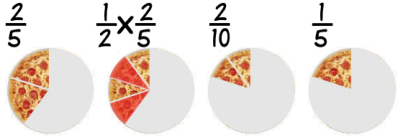
Multiplying Fractions
Multiply the tops, multiply the bottoms.
There are 3 simple steps to multiply fractions
1. Multiply the top numbers (the numerators).
2. Multiply the bottom numbers (the denominators).
Earlier in this chapter we have expressed linear equations using the standard form Ax + By = C. Now we're going to show another way of expressing linear equations by using the slope-intercept form y = mx + b.
In the slope-intercept form you use the slope of the line and the y-intercept to express the linear function.
y=mx+b
Where m is the slope and b is the y-intercept.
Example
Graph the equation
y−2x=1
rewrite in slope-intercept form
y=2x+1
Identify the slope and the y-intercept
m = 2 and b = 1
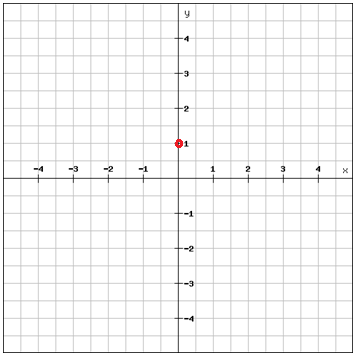
Plot the point corresponding to the y-intercept, (0,1)
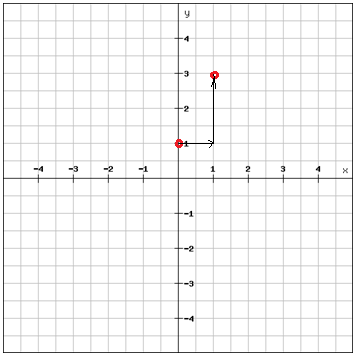
The m-value, the slope, tells us that for each step to the right on the x-axis we move 2 steps upwards on the y-axis (since m = 2)
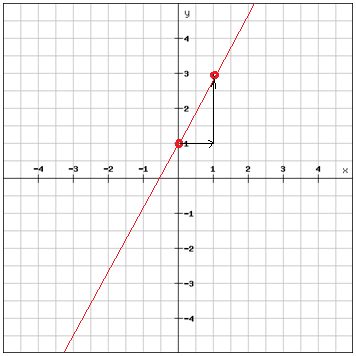
And once you have your second point you can just draw a line through the two points and extend it in both directions.
You can check to see that the line you've drawn is the correct one by substituting the coordinates of the second point into the original equation. If the equation holds true than the second point is correct.
Our second point = (1, 3)
y−2x=1
3−2⋅1=3−2=1
Our second point is a solution to the equation i.e. the line we drew is correct.
A line that passes through the origin has a y-intersect of zero, b = 0, and represents a direct variation.
y=mx
In a direct variation the nonzero number m is called the constant of variation.
You can name a function, f by using the function notion
f(x)=mx+b
f(x) is another name for y and is read as "the value of f at x" or "f of x". You can use other letters than f to name functions.
A group of functions that have similar characteristics are called a family of functions. All functions that can be written on the form f(x) = mx + b belong to the family of linear functions.
The most basic function in a family of functions is called the parent function. The parent function of all linear functions is