Monday, April 15, 2019

Week of April 15, 2019

Biology

Tutoring Schedule

Super Saturday - 4/20 - (9.a.m - noon)
Monday 4/22 - 3.45- 5 p.m
Tuesday 4/23 - 3.45- 5 p.m
Wednesday 4/24 - 3.45- 5 p.m
Thursday 4/25 - 3.45- 5 p.m
Monday 4/29 - 3.45- 5 p.m
Tuesday 4/30 - 3.45- 5 p.m
Wednesday 5/1 - 3.45- 5 p.m
Thursday 5/2 - 3.45- 5 p.m  Test-taking skills


Astronomy
Coriolis effect


The Coriolis effect describes the pattern of deflection taken by objects not firmly connected to the ground as they travel long distances around the Earth.
The Coriolis effect describes the pattern of deflection taken by objects not firmly connected to the ground as they travel long distances around and above the Earth. The Coriolis effect is responsible for many large-scale weather patterns.
 
The key to the Coriolis effect lies in the Earth’s rotation. Specifically, the Earth rotates faster at the Equator than it does at the poles. Earth is wider at the Equator, so to make a rotation in one 24-hour period, equatorial regions race nearly 1,674 kilometers per hour (1,040 miles per hour). Near the poles, the Earth rotates at a sluggish .00008 kph (.00005 mph). 
 
Let’s pretend you’re standing at the Equator and you want to throw a ball to your friend in the middle of North America. If you throw the ball in a straight line, it will appear to land to the right of your friend because he’s moving slower and has not caught up.
 
Now let’s pretend you’re standing at the North Pole. When you throw the ball to your friend, it will again to appear to land to the right of him. But this time, it’s because he’s moving faster than you are and has moved ahead of the ball.
 
Everywhere you play global-scale "catch" in the Northern Hemisphere, the ball will deflect to the right.
 
This apparent deflection is the Coriolis effect. Fluids traveling across large areas, such as air currents, are like the path of the ball. They appear to bend to the right in the Northern Hemisphere. The Coriolis effect behaves the opposite way in the Southern Hemisphere, where currents to bend to the left.
 
The impact of the Coriolis effect is dependent on velocity—the velocity of the Earth and the velocity of the object or fluid being deflected by the Coriolis effect. The impact of the Coriolis effect is most significant with high speeds or long distances. 
 
Weather Patterns
 
The development of weather patterns, such as cyclones and trade winds, are examples of the impact of the Coriolis effect.
 
Cyclones are low-pressure systems that suck air into their center “eye.” In the Northern Hemisphere, fluids from high-pressure systems pass low-pressure systems to their right. As air masses are pulled into cyclones from all directions, they are deflected, and the storm system—a hurricane—seems to rotate counter-clockwise.
 
In the Southern Hemisphere, currents are deflected to the left. As a result, storm systems seem to rotate clockwise.
 
Outside storm systems, the impact of the Coriolis effect helps define regular wind patterns around the globe. 
 
As warm air rises near the Equator, for instance, it flows toward the poles. In the Northern Hemisphere, these warm air currents are deflected to the right (east) as they move northward. The currents descend back toward Earth at about 30° north latitude. As the current descends, it gradually moves from the northeast to the southwest, back toward the Equator. The consistently circulating patterns of these air masses are known as trade winds.
 
Impact on Human Activity
 
The weather impacting fast-moving objects, such as airplanes and rockets, is influenced by the Coriolis effect. The directions of prevailing winds are largely determined by the Coriolis effect, and pilots must take that into account when charting flight paths over long distances. 
 
Military snipers sometimes have to consider the Coriolis effect. Although the trajectory of bullets is too short to be greatly impacted by the Earth’s rotation, sniper targeting is so precise that a deflection of several centimeters could injure innocent people or damage civilian infrastructure.
 
The Coriolis Effect on Other Planets
 
The Earth rotates fairly slowly, compared with other planets. The slow rotation of the Earth means the Coriolis effect is not strong enough to be seen at slow speeds over short distances, such as the draining of water in a bathtub. 
 
Jupiter, on the other hand, has the fastest rotation in the solar system. On Jupiter, the Coriolis effect actually transforms north-south winds into east-west winds, some traveling more than 610 kilometers per hour (380 miles per hour). 
 
The divisions between winds that blow mostly to the east and those that blow mostly to the west create clear horizontal divisions, called belts, among the planet’s clouds. The boundaries between these fast-moving belts are incredibly active storm regions. The 180-year-old Great Red Spot is perhaps the most famous of these storms.
 
The Coriolis Effect Closer to Home
 
Despite the popular urban legend, you cannot observe the Coriolis effect by watching a toilet flush or a swimming pool drain. The movement of fluids in these basins is dependent on manufacturer’s design (toilet) or outside forces such as a strong breeze or movement of swimmers (pool).
 
You can observe the Coriolis effect without access to satellite imagery of hurricanes, however. You could observe the Coriolis effect if you and some friends sat on a rotating merry-go-round and threw or rolled a ball back and forth. 
 
When the merry-go-round is not rotating, rolling the ball back-and-forth is simple and straightforward. While the merry-go-round is rotating, however, the ball won’t make to your friend sitting across from you without significant force. Rolled with regular effort, the ball appears to curve, or deflect, to the right. 
 
Actually, the ball is traveling in a straight line. Another friend, standing on the ground near the merry-go-round, will be able to tell you this. You and your friends on the merry-go-round are moving out of the path of the ball while it is in the air. 
Coriolis effect
Storms in the north swing counter-clockwise: the Coriolis effect.
Storms in the south swing with the clock, and winds tend to pass to the left!
Coriolis Force
The invisible force that appears to deflect the wind is the Coriolis force. The Coriolis force applies to movement on rotating objects. It is determined by the mass of the object and the object's rate of rotation. The Coriolis force is perpendicular to the object's axis. The Earth spins on its axis from west to east. The Coriolis force, therefore, acts in a north-south direction. The Coriolis force is zero at the Equator.

Though the Coriolis force is useful in mathematical equations, there is actually no physical force involved. Instead, it is just the ground moving at a different speed than an object in the air.
Polar Power
The Coriolis force is strongest near the poles, and absent at the Equator. Cyclones need the Coriolis force in order to circulate. For this reasons, hurricanes almost never occur in equatorial regions, and never cross the Equator itself.

Source:https://www.nationalgeographic.org/encyclopedia/coriolis-effect/

Monday, April 8, 2019

Week of April 8, 2019

Astronomy

Is the Earth round?

The Earth is an irregularly shaped ellipsoid.

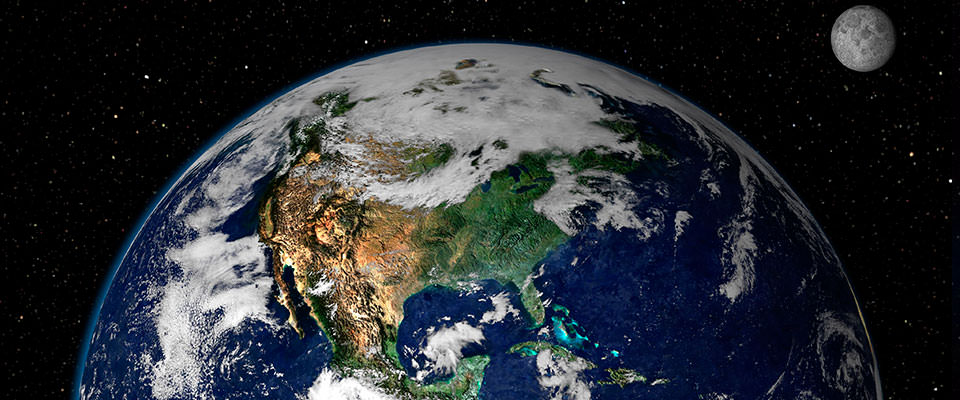
Earth from space
This NASA image shows Earth from space. The image is a combination of data from two satellites. The Moderate Resolution Imaging Spectroradiometer (MODIS) instrument aboard NASA’s Terra satellite collected the land surface data over 16 days, while NOAA’s Geostationary Operational Environmental Satellite (GOES) produced a snapshot of the Earth’s clouds.
While the Earth appears to be round when viewed from the vantage point of space, it is actually closer to an ellipsoid. However, even an ellipsoid does not adequately describe the Earth’s unique and ever-changing shape.
Our planet is pudgier at the equator than at the poles by about 70,000 feet. This is due to the centrifugal force created by the earth’s constant rotation. Mountains rising almost 30,000 feet and ocean trenches diving over 36,000 feet (compared to sea level) further distort the shape of the Earth. Sea level itself is even irregularly shaped. Slight variations in Earth’s gravity field cause permanent hills and valleys in the ocean’s surface of over 300 feet relative to an ellipsoid.
Additionally, the shape of the Earth is always changing. Sometimes this change is periodic, as is the case with daily tides that affect both the ocean and the crust; sometimes the change is slow and steady, as with the drift of tectonic plates or the rebound of the crust after a heavy sheet of ice has melted; and sometimes the shape of the planet changes in violent, episodic ways during events such as earthquakes, volcanic eruptions, or meteor strikes.
The National Geodetic Survey measures and monitors our ever-changing planet. Geodesy is the science of measuring and monitoring the size and shape of the Earth, including its gravity field, and determining the location of points on the Earth’s surface.
Source: 
https://oceanservice.noaa.gov/facts/earth-round.html

BIOLOGY

What is evolution and how does it work?
Sub-topics (containing additional resources):
Evo-Devo , Examples of evolution , Genetics , History of life on Earth , Macroevolution , Microevolution , Natural selection , Speciation 
Resources:
image
Evolution 101
This in-depth, multi-part course takes you through evolutionary theory and mechanisms, from definitions to details, natural selection to genetic drift, mutations to punctuated equilibrium.
image
Evolutionary trees and patterns in the history of life
Scientists use many different lines of evidence to reconstruct the evolutionary trees that show how species are related.
This article is located within Evolution 101.
image
Mechanisms of evolution
Learn about the basic processes that have shaped life and produced its amazing diversity.
This article is located within Evolution 101.
image
Evolution at different scales: Micro to macro
Microevolution and macroevolution encompass change at very different scales, but both work through the same basic processes.
image
Evolution and the fossil record
Evolution is a fundamental concept in modern biology. Review the basics of how evolution works with a special focus on evidence and examples from the fossil record.
This article appears at the American Geological Institute website.
image
Webcast: Endless forms most beautiful
In lecture one of a four part series, evolutionary biologist Sean Carroll discusses Darwin and his two most important ideas: natural selection and common ancestry.
This lecture is available from Howard Hughes' BioInteractive website.
image
Learn about the tree of life
This tutorial on phylogenetics explains the basics of tree-thinking and provides many examples from real organisms.
This resource is available from the Peabody Museum of Natural History
image
Discovering the great tree of life
This short video introduces basic concepts in phylogenetics and provides a model to help understand lineage-splitting.
This resource is available from the Peabody Museum of Natural History
image
Evo in the news: Coping with climate change
This news brief from May 2009 explores the difference between phenotypic plasticity and evolutionary change in relation to the media's coverage of climate change.
image
A name by any other tree
Phylogenetics has affected almost every area of biology - even the most basic one: how we classify organisms. Find out how phylogenetic classification works and what its advantages are.
This article appears at SpringerLink.
image
Darwin
This website, which was produced to accompany an exhibit at the American Museum of Natural History, describes Darwin's life and how his ideas transformed our understanding of the living world.
This article appears on the American Museum of Natural History website.
image
Interview: Geerat Vermeij on the Fossil record  Advanced
This interview with MacArthur Fellow and paleobiologist, Geerat Vermeij, covers much ground, including adaptations in the mollusks he studies, evolutionary arms races, punctuated equilibrium, extinctions, macroevolution, and the value of diversity.
image
A closer look at a classic ring species: The work of Tom Devitt
The Ensatina salamander has been extensively investigated because it is a ring species — a species that demonstrates how geography and the gradual accumulation of genetic differences factor into the process of speciation. Biologist Tom Devitt continues the more than 50 years of Ensatina research by applying new genetic techniques and asking new questions about this classic evolutionary example.
image
Evolution: Applications in human health and populations  Advanced
In a series of six lectures, scientists describe how evolutionary theory makes contributions to the field of human health through studies of the human genome, physiology, lifestyle, and interaction with the environment.
This resource appears at the National Evolutionary Synthesis Center website.
image
Understanding evolutionary trees  Advanced
Many disciplines within biology (and many basic biology texts) have come to depend on evolutionary trees. Get the basics you need to understand and interpret these key diagrams.
This article appears at SpringerLink.
image
Phylogenetic systematics, a.k.a. evolutionary trees  Advanced
Learn about phylogenetic systematics, the study of the evolutionary relationships among organisms, and how the field is shaping biological research today.
image
Tree thinking basics
Tree thinking, or phylogenetics, is an important way of understanding evolutionary relationships. Reading trees correctly can pose some challenges. This video introduces the basics of three reading and addresses common problems in tree reading.
This resource is available from the National Evolutionary Synthesis Center
image
Tree thinking challenges
In the this interactive video, college students guide viewers through problems on phylogenetics and address some of the misconceptions that many students have with the subject.
This resource is available from the National Evolutionary Synthesis Center
image
Evo in the News: Hybrid sharks aren't "trying" to adapt
This news brief, from February 2012, describes the discovery of hybrid sharks in Australian waters, debunks some common misconceptions regarding the discovery, and examines the possible evolutionary trajectories of these animals.
image
Evo in the News: A new look at dinosaur fossils pushes back the evolution of feathered wings
This news brief, from November 2012, describes what a new dinosaur fossil from North America has to tell us about the evolution of feathers.
image
Evolución 101
¿Qué es la evolución y cómo funciona? Introducción a la evolución ofrece información detallada y práctica sobre los patrones y los mecanismos de la evolución.
image
Evo in the news: The legless lizards of LAX
This news brief from October 2013 describes the discovery of four new species of legless lizard. Why don't we just call these animals snakes? Because of their evolutionary history...
image
Radiations and extinctions: Biodiversity through the ages
This excerpted chapter from Carl Zimmer's book, The Tangled Bank, describes the evolutionary processes responsible for large scale patterns in the diversity of life through time. Reprinted with the permission of Roberts and Company Publishers, Inc.
This resource is available from the National Center for Science Education.
image
Understanding evolutionary history: An introduction to tree thinking
This pamphlet with self-quizzes provides students with a self-paced tutorial in tree thinking and corrects many common misconceptions about phylogenetic trees.
image
Tree of Life poster without images (large)
Print this 28x36" poster for your classroom wall. For ideas about how to use the poster in your class, visit Two- and Ten-minute Trees.
image
Tree of Life poster without images (medium)
Print this 18x24" poster for your classroom wall. For ideas about how to use the poster in your class, visit Two- and Ten-minute Trees.
image
Tree of life poster with images (large)
Print this 28x36" poster for your classroom wall. For ideas about how to use the poster in your class, visit Two- and Ten-minute Trees.


Source:https://evolution.berkeley.edu/evolibrary/search/topics.php?topic_id=13