Tuesday, September 3, 2019

Week of September 3, 2019


P a r e n t U n i v e r s i t y S e r i e s
  
Understanding the IEP Process


Presented by the

CCSD Special Education Department


MONDAY, SEPTEMBER 16, 2019

6:30 - 8:30 PM @ Pine Mountain Middle School

2720 Pine Mountain Cir, Kennesaw, GA 30152


P l e a s e  r e s e r v e  y o u r  s p o t  f o r  t h e  p r o g r a m  b y  c a l l i n g  t h e  S p e c i a l  E d u c a t i o n P a r e n t  M e n t o r  o f f i c e  a t  7 7 0 - 5 2 9 - 0 0 4 6  o r  b y  r e g i s t e r i n g  a t  t h i s  l i n k :


How to Tell If Two Functions Are Inverses


Monday, August 26, 2019

Week of August 26, 2019

Open House

Tomorrow 8/17/19 @ 6.p.m.

Pascal's Triangle

One of the most interesting Number Patterns is Pascal's Triangle (named after Blaise Pascal, a famous French Mathematician and Philosopher).
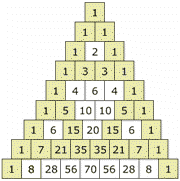
To build the triangle, start with "1" at the top, then continue placing numbers below it in a triangular pattern. 

Each number is the numbers directly above it added together.
(Here I have highlighted that 1+3 = 4)

Patterns Within the Triangle

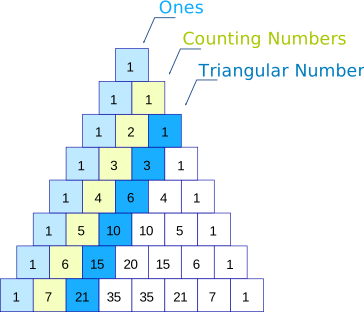
pascals triangle 1s, counting, triangular

Diagonals

The first diagonal is, of course, just "1"s
The next diagonal has the Counting Numbers(1,2,3, etc).
The third diagonal has the triangular numbers
(The fourth diagonal, not highlighted, has the tetrahedral numbers.)

Pascal's Triangle Symmetry

Symmetrical

The triangle is also symmetrical. The numbers on the left side have identical matching numbers on the right side, like a mirror image.

pascals triangle powers 2

Horizontal Sums

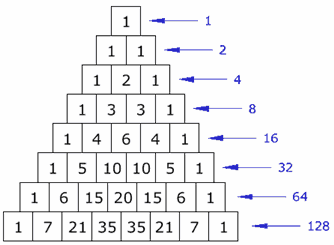
What do you notice about the horizontal sums?
Is there a pattern?
They double each time (powers of 2).

pascals triangle powers 11

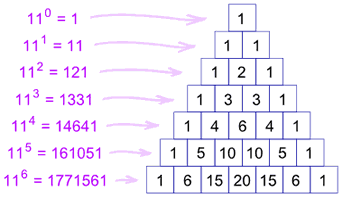
Exponents of 11

Each line is also the powers (exponents) of 11:
  • 110=1 (the first line is just a "1")
  • 111=11 (the second line is "1" and "1")
  • 112=121 (the third line is "1", "2", "1")
  • etc!
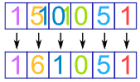
But what happens with 115 ? Simple! The digits just overlap, like this:
pascals triangle powers 11b
The same thing happens with 116 etc.

pascals triangle squares

Squares

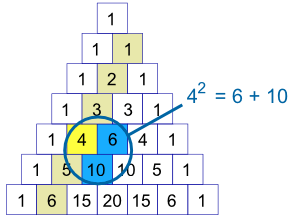
For the second diagonal, the square of a number is equal to the sum of the numbers next to it and below both of those.
Examples:
  • 32 = 3 + 6 = 9,
  • 42 = 6 + 10 = 16,
  • 52 = 10 + 15 = 25,
  • ...
There is a good reason, too ... can you think of it? (Hint: 42=6+10, 6=3+2+1, and 10=4+3+2+1)

pascals triangle fibonacci

Fibonacci Sequence

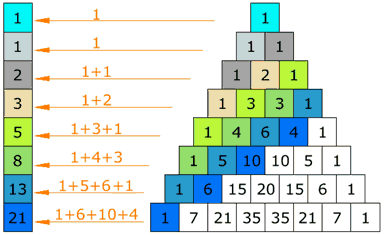
Try this: make a pattern by going up and then along, then add up the values (as illustrated) ... you will get the Fibonacci Sequence.

(The Fibonacci Sequence starts "0, 1" and then continues by adding the two previous numbers, for example 3+5=8, then 5+8=13, etc)

pascals triangle 3

Odds and Evens

If you color the Odd and Even numbers, you end up with a pattern the same as the Sierpinski Triangle

Using Pascal's Triangle

Heads and Tails

Pascal's Triangle can show you how many ways heads and tails can combine. This can then show you the probability of any combination.
For example, if you toss a coin three times, there is only one combination that will give you three heads (HHH), but there are three that will give two heads and one tail (HHT, HTH, THH), also three that give one head and two tails (HTT, THT, TTH) and one for all Tails (TTT). This is the pattern "1,3,3,1" in Pascal's Triangle.
TossesPossible Results (Grouped)Pascal's Triangle
1H
T
1, 1
2HH
HT TH
TT
1, 2, 1
3HHH
HHT, HTH, THH
HTT, THT, TTH
TTT
1, 3, 3, 1
4HHHH
HHHT, HHTH, HTHH, THHH
HHTT, HTHT, HTTH, THHT, THTH, TTHH
HTTT, THTT, TTHT, TTTH
TTTT
1, 4, 6, 4, 1
 ... etc ... 

Example: What is the probability of getting exactly two heads with 4 coin tosses?

There are 1+4+6+4+1 = 16 (or 24=16) possible results, and 6 of them give exactly two heads. So the probability is 6/16, or 37.5%

Combinations

The triangle also shows you how many Combinations of objects are possible.

Example: You have 16 pool balls. How many different ways could you choose just 3 of them (ignoring the order that you select them)?

Answer: go down to the start of row 16 (the top row is 0), and then along 3 places (the first place is 0) and the value there is your answer, 560.
Here is an extract at row 16:
1    14    91    364  ...
1    15    105   455   1365  ...
1    16   120   560   1820  4368  ...


A Formula for Any Entry in The Triangle

In fact there is a formula from Combinations for working out the value at any place in Pascal's triangle:
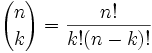
It is commonly called "n choose k" and written like this: n choose k = n! / k!(n-k)!
Notation: "n choose k" can also be written C(n,k), nCk or even nCk.

Factorial SymbolThe "!" is "factorial" and means to multiply a series of descending natural numbers. Examples:
  • 4! = 4 × 3 × 2 × 1 = 24
  • 7! = 7 × 6 × 5 × 4 × 3 × 2 × 1 = 5040
  • 1! = 1

Pascals Triangle Combinations
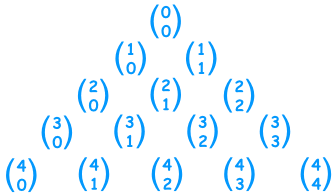
So Pascal's Triangle could also be
an "n choose k" triangle like this one.
(Note how the top row is row zero
and also the leftmost column is zero)

Example: Row 4, term 2 in Pascal's Triangle is "6" ...

... let's see if the formula works:
4 choose 2 = 4! / 2!(4-2)! = (4x3x2x1)/(2x1x2x1) = 6
Yes, it works! Try another value for yourself.
This can be very useful ... you can now work out any value in Pascal's Triangle directly (without calculating the whole triangle above it).

Polynomials

Pascal's Triangle can also show you the coefficients in binomial expansion:
PowerBinomial ExpansionPascal's Triangle
2(x + 1)2 = 1x2 + 2x + 11, 2, 1
3(x + 1)3 = 1x3 + 3x2 + 3x + 11, 3, 3, 1
4(x + 1)4 = 1x4 + 4x3 + 6x2 + 4x + 11, 4, 6, 4, 1
 ... etc ... 

The First 15 Lines

For reference, I have included row 0 to 14 of Pascal's Triangle
1
1
1
1
2
1
1
3
3
1
1
4
6
4
1
1
5
10
10
5
1
1
6
15
20
15
6
1
1
7
21
35
35
21
7
1
1
8
28
56
70
56
28
8
1
1
9
36
84
126
126
84
36
9
1
1
10
45
120
210
252
210
120
45
10
1
1
11
55
165
330
462
462
330
165
55
11
1
1
12
66
220
495
792
924
792
495
220
66
12
1
1
13
78
286
715
1287
1716
1716
1287
715
286
78
13
1
1
14
91
364
1001
2002
3003
3432
3003
2002
1001
364
91
14
1

Monday, August 19, 2019

Week of August 18,2019

Adding and Subtracting Polynomials

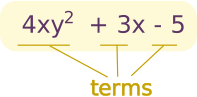
A polynomial looks like this:
polynomial example
example of a polynomial
this one has 3 terms
To add polynomials we simply add any like terms together ... so what is a like term?

Like Terms

Like Terms are terms whose variables (and their exponents such as the 2 in x2) are the same.
In other words, terms that are "like" each other.
Note: the coefficients (the numbers you multiply by, such as "5" in 5x) can be different.

Example:

7xx-2xπx
are all like terms because the variables are all x

Example:

(1/3)xy2-2xy26xy2xy2/2
are all like terms because the variables are all xy2

Example: These are NOT like terms because the variables and/or their exponents are different:

2x2x22y2xy

Adding Polynomials

Two Steps:
  • Place like terms together
  • Add the like terms
Example: Add   2x2 + 6x + 5   and   3x2 - 2x - 1

Start with:2x2 + 6x + 5   +   3x2 − 2x − 1
Place like terms together:2x2+3x2   +   6x−2x   +   5−1
Which is:(2+3)x2  +   (6−2)x   +   (5−1)
Add the like terms:5x2  +   4x   +   4
Here is an animated example:

(Note: there was no "like term" for the -7 in the other polynomial, so we didn't have to add anything to it.)

Adding in Columns

We can also add them in columns like this:

Adding Several Polynomials

We can add several polynomials together like that.
Example: Add     (2x2 + 6y + 3xy)  ,   (3x2 - 5xy - x)   and   (6xy + 5)
Line them up in columns and add:
2x2 + 6y + 3xy
3x2      - 5xy - x
           6xy     + 5
5x2 + 6y + 4xy - x + 5
Using columns helps us to match the correct terms together in a complicated sum.

Subtracting Polynomials

To subtract Polynomials, first reverse the sign of each term we are subtracting (in other words turn "+" into "-", and "-" into "+"), then add as usual.
Like this:

Note: After subtracting 2xy from 2xy we ended up with 0, so there is no need to mention the "xy" term any more.


Monday, August 12, 2019

Week of August 12, 2019

Factoring

Factors

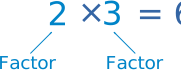
Numbers have factors:
factors 2x3=6
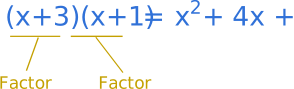
And expressions (like x2+4x+3) also have factors:
factors

Factoring

Factoring (called "Factorising" in the UK) is the process of finding the factors:
Factoring: Finding what to multiply together to get an expression.
It is like "splitting" an expression into a multiplication of simpler expressions.

Example: factor 2y+6

Both 2y and 6 have a common factor of 2:
  • 2y is 2 × y
  • 6 is 2 × 3
So we can factor the whole expression into:
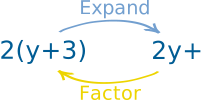
2y+6 = 2(y+3)
So 2y+6 has been "factored into" 2 and y+3
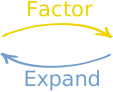
Factoring is also the opposite of Expanding:
expand vs factor

Common Factor

In the previous example we saw that 2y and 6 had a common factor of 2
But to do the job properly we need the highest common factor, including any variables

Example: factor 3y2+12y

Firstly, 3 and 12 have a common factor of 3.
So we could have:
3y2+12y = 3(y2+4y)
But we can do better!
3y2 and 12y also share the variable y.
Together that makes 3y:
  • 3y2 is 3y × y
  • 12y is 3y × 4

So we can factor the whole expression into:
3y2+12y = 3y(y+4)

Check: 3y(y+4) = 3y × y + 3y × 4 = 3y2+12y

More Complicated Factoring

Factoring Can Be Hard !

The examples have been simple so far, but factoring can be very tricky.
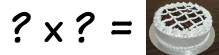
Because we have to figure what got multiplied to produce the expression we are given!

factoring cake
It is like trying to find which ingredients
went into a cake to make it so delicious.
It can be hard to figure out!

Experience Helps

With more experience factoring becomes easier.

Example: Factor 4x2 − 9

Hmmm... there don't seem to be any common factors.
But knowing the Special Binomial Products gives us a clue called the "difference of squares":
difference of squares
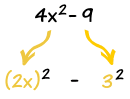
Because 4x2 is (2x)2, and 9 is (3)2,
So we have:
4x2 − 9 = (2x)2 − (3)2
And that can be produced by the difference of squares formula:
(a+b)(a−b) = a2 − b2
Where a is 2x, and b is 3.
So let us try doing that:
(2x+3)(2x−3) = (2x)2 − (3)2 = 4x2 − 9
Yes!

So the factors of 4x2 − 9 are (2x+3) and (2x−3):
Answer: 4x2 − 9 = (2x+3)(2x−3)
How can you learn to do that? By getting lots of practice, and knowing "Identities"!

Remember these Identities

Here is a list of common "Identities" (including the "difference of squares" used above).
It is worth remembering these, as they can make factoring easier.
factor expand
a2 − b2 = (a+b)(a−b)
a2 + 2ab + b2 = (a+b)(a+b)
a2 − 2ab + b2 = (a−b)(a−b)
a3 + b3 = (a+b)(a2−ab+b2)
a3 − b3 = (a−b)(a2+ab+b2)
a3+3a2b+3ab2+b3 = (a+b)3
a3−3a2b+3ab2−b3 = (a−b)3
There are many more like those, but those are the most useful ones.

Advice

The factored form is usually best.
When trying to factor, follow these steps:
  • "Factor out" any common terms
  • See if it fits any of the identities, plus any more you may know
  • Keep going till you can't factor any more
There are also Computer Algebra Systems (called "CAS") such as Axiom, Derive, Macsyma, Maple, Mathematica, MuPAD, Reduce and many more that are good at factoring.

More Examples

Experience does help, so here are more examples to help you on the way:

Example: w4 − 16

An exponent of 4? Maybe we could try an exponent of 2:
w4 − 16 = (w2)2 − 42
Yes, it is the difference of squares
w4 − 16 = (w2 + 4)(w2 − 4)
And "(w2 − 4)" is another difference of squares
w4 − 16 = (w2 + 4)(w + 2)(w − 2)
That is as far as I can go (unless I use imaginary numbers)

Example: 3u4 − 24uv3

Remove common factor "3u":
3u4 − 24uv3 = 3u(u3 − 8v3)
Then a difference of cubes:
3u4 − 24uv3 = 3u(u3 − (2v)3)
= 3u(u−2v)(u2+2uv+4v2)
That is as far as I can go.

Example: z3 − z2 − 9z + 9

Try factoring the first two and second two separately:
z2(z−1) − 9(z−1)
Wow, (z-1) is on both, so let us use that:
(z2−9)(z−1)
And z2−9 is a difference of squares
(z−3)(z+3)(z−1)