Monday, November 4, 2019

Week of November 4, 2019

Slant (Oblique) Asymptotes

In the previous section, covering horizontal asymptotes, we learned how to deal with rational functions where the degree of the numerator was equal to or less than that of the denominator. But what happens if the degree is greater in the numerator than in the denominator?
Recall that, when the degree of the denominator was bigger than that of the numerator, we saw that the value in the denominator got so much bigger, so quickly, that it was so much "stronger" that it "pulled" the functional value down to zero, giving us a horizontal asymptote of the x-axi
Reasonably, then, if the numerator has a power that is larger than that of the denominator, then the value of the numerator ought to be "stronger", and ought to "pull" the graph away from the x-axis (that is, the line y = 0) or any other fixed y-value.
To investigate this, let's look at the following function:
y = \dfrac{-3x^2 + 2}{x - 1}
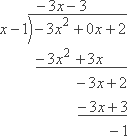
For reasons that will shortly become clear, I'm going to apply long polynomial division to this rational expression. My work looks like this:
long division
Across the top is the quotient, being the linear polynomial expression –3x – 3. At the bottom is the remainder. This means that, via long division, I can convert the original rational function they gave me into something akin to mixed-number format:
y = -3x - 3 + \dfrac{-1}{x - 1}
This is the exact same function. All I've done is rearrange it a bit. Why? You're about to see.
First, take a look at the graph of the rational function they gave us:
graph of y = [–3x^2 + 2] / [x – 1]
Thinking back to the results of my long division, you know what the graph of y = –3x – 3 looks like; it's a decreasing straight line, crossing the y-axis at –3 and having a slope of m = –3.
Now take a look at this second graph of the same rational function, but with the line y = –3x – 3superimposed on it:
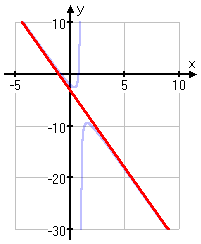
graph of y = -3x - 3
As you can see, apart from the middle of the plot near the origin, the graph hugs the line y = –3x – 3. Because of this "skinnying along the line" behavior of the graph, the line y = –3x – 3 is an asymptote. Clearly, it's not a horizontal asymptote. Instead, because its line is slanted or, in fancy terminology, "oblique", this is called a "slant" (or "oblique") asymptote.
The graphs show that, if the degree of the numerator is exactly one more than the degree of the denominator (so that the polynomial fraction is "improper"), then the graph of the rational function will be, roughly, a slanty straight line with some fiddly bits in the middle. Because the graph will be nearly equal to this slanted straight-line equivalent, the asymptote for this sort of rational function is called a "slant" (or "oblique") asymptote. The equation for the slant asymptote is the polynomial part of the rational that you get after doing the long division.
By the way, this relationship — between an improper rational function, its associated polynomial, and the graph — holds true regardless of the difference in the degrees of the numerator and denominator. However, in most textbooks, they only have you work with a degree-difference of one.
  • Find the slant asymptote of the following function:

\mathbf{\color{green}{\mathit{y} = \dfrac{\mathit{x}^2 + 3\mathit{x} + 2}{\mathit{x} - 2}}}
To find the slant asymptote, I'll do the long division:
long division, resulting in: y = x + 5, plus 12/(x – 2]
I need to remember that the slant asymptote is the polynomial part of the answer (that is, the part across the top of the division), not the remainder (that is, not the last value at the bottom). Then my answer is:
slant asymptote: y = x + 5

Monday, October 28, 2019

Week of October 28, 2019

Asymptotes and Graphing Rational Functions

To graph a rational function, find the asymptotes and intercepts, plot a few points on each side of each vertical asymptote and then sketch the graph.

Finding Asymptotes

Vertical asymptotes are "holes" in the graph where the function cannot have a value.  They stand for places where the x-value is not allowed.  Specifically, the denominator of a rational function cannot be equal to zero.  Any value of x that would make the denominator equal to zero is a vertical asymptote. 

It is common practice to draw a dotted line through any vertical asymptote values to denote that the function cannot exist in those places.  The vertical asymptotes inform the domain of the graph.  Specifically, the domain of the graph will be any allowable numbers other than those that create a zero in the denominator — i.e.,  the vertical asymptotes are excluded from the domain.

Horizontal and Slant Asymptotes

A horizontal or slant asymptote shows us which direction the graph will tend toward as its x-values increase.  Unlike the vertical asymptote, it is permissible for the graph to touch or cross a horizontal or slant asymptote.

To find the horizontal or slant asymptotecompare the degrees of the numerator and denominator.


Horizontal Asymptote

If the degree of x in the denominator is larger than the degree of x in the numerator, then the denominator, being "stronger", pulls the fraction down to the x-axis when x gets big. That is, if the polynomial in the denominator has a bigger leading exponent than the polynomial in the numerator, then the graph trails along the x-axis at the far right and the far left of the graph.  The x-axis becomes the horizontal asymptote.

When the degrees of the numerator and the denominator are the same, then the horizontal asymptote is found by dividing the leading terms, so the asymptote is given by:

y = (numerator's leading coefficient) / (denominator's leading coefficient)

The horizontal asymptote may also be approximated by inputting very large positive or negative values of x.

Slant Asymptote

If the numerator is one degree greater than the denominator, the graph has a slant asymptote.  Using polynomial division, divide the numerator by the denominator to determine the line of the slant asymptote.


Finding Intercepts

To find x and y intercepts, set each variable equal to zero and solve in turn.

Plotting Points

Based on information gained so far, select x values and determine y values to create a chart of points to plot.  Select more plots in areas where you think you need information to inform your curve.

Sketching the Graph

Once the points are plotted, remember that rational functions curve toward the asymptotes.  Include additional points to help determine any areas of uncertainty.  In addition, graphing calculators are often used in conjunction with sketches to define the graph.


Example

Graph:
 

1.  Find the vertical asymptotes.
Factor the denominator:  (x + 2)(x - 2) and set equal to zero.
x cannot be 2 or -2, so the vertical asymptotes are x = 2 and x = -2
Sketch these as dotted lines on the graph.

2.  Find the horizontal or slant asymptotes.
Since the degree of the numerator is 1 and the degree of the denominator is 2, y = 0 is the horizontal asymptote.  There is no slant asymptote.  Sketch on the graph.

3.  Find the intercepts
      Set x = 0; y = 0
      Set y = 0; x = 0
      Intercept is (0, 0)

4.  Plot points on either side of the asymptotes.
Select values for x and determine values of y.  Plot.


5.  Sketch the graph.  Consider that the graph must "take off" near the vertical asymptotes and "level off" near the horizontal asymptote.  Sketch with appropriate curves.


Practice

Follow the steps to graph each rational function:
1.  Find the vertical asymptotes.
2.  Find any horizontal/slant asymptotes.
3.  Find intercepts.
4.  Plot points.
5.  Sketch the graph.


1)  y = 1/x


2)  y = x2/(x - 1)


3)        


Answer Key 

1) 

2)  

3)   

Source:https://www.brainfuse.com/jsp/alc/resource.jsp?s=gre&c=36982&cc=108825

Monday, October 21, 2019

Week of October 21, 2019

Asymptotes

In general, you will be given a rational (fractional) function, and you will need to find the domain and any asymptotes. You'll need to find the vertical asymptotes, if any, and then figure out whether you've got a horizontal or slant asymptote, and what it is. To make sure you arrive at the correct (and complete) answer, you will need to know what steps to take and how to recognize the different types of asymptotes.
Let's get some practice:
  • Find the domain and all asymptotes of the following function:

\mathbf{\color{green}{\mathit{y} = \dfrac{\mathit{x}^2 + 3\mathit{x} + 1}{4\mathit{x}^2 - 9}}}
I'll start with the vertical asymptotes.
They (and any restrictions on the domain) will be generated by the zeroes of the denominator, so I'll set the denominator equal to zero and solve.
4x^2 - 9 = 0
4x^2 = 9
x^2 = \dfrac{9}{4}
x = \pm \dfrac{3}{2}
Then the domain is all x-values other than \pm \frac{3}{2}, and the two vertical asymptotes are at x = \pm \frac{3}{2}.
Next I'll turn to the issue of horizontal or slant asymptotes.
Since the degrees of the numerator and the denominator are the same (each being 2), then this rational has a non-zero (that is, a non-x-axis) horizontal asymptote, and does not have a slant asymptote. The horizontal asymptote is found by dividing the leading terms:
y = \dfrac{x^2}{4x^2} = \dfrac{1}{4}
Then the full answer is:
domain: \mathbf{\color{purple}{ \mathit{x} \neq \pm \frac{3}{2} }}
vertical asymptotes: \mathbf{\color{purple}{ \mathit{x} = \pm \frac{3}{2} }}
horizontal asymptote: \mathbf{\color{purple}{ \mathit{y} = \frac{1}{4} }}
slant asymptote: none

A given rational function may or may not have a vertical asymptote (depending upon whether the denominator ever equals zero), but (at this level of study) it will always have either a horizontal or else a slant asymptote.
Note, however, that the function will only have one of these two; you will have either a horizontal asymptote or else a slant asymptote, but not both. As soon as you see that you have one of them, don't bother looking for the other one.
  • Find the domain and all asymptotes of the following function:

\mathbf{\color{green}{\mathit{y} = \dfrac{\mathit{x} + 3}{\mathit{x}^2 + 9}}}
The vertical asymptotes come from the zeroes of the denominator, so I'll set the denominator equal to zero and solve.
x2 + 9 = 0
x2 = –9
Oops! This has no solution. (Duh! The denominator is a sum of squares, not a difference. So of course it doesn't factor and it can't have real zeroes. I should remember to look out for this, and save myself some time in the future.)
Since the denominator has no zeroes, then there are no vertical asymptotes and the domain is "all x".
Since the degree is greater in the denominator than in the numerator, the y-values will be dragged down to the x-axis and the horizontal asymptote is therefore "y = 0". Since I have found a horizontal asymptote, I don't have to look for a slant asymptote.
My full answer is:
domain: all x
vertical asymptotes: none
horizontal asymptote: y = 0 (the x-axis)
slant asymptote: none

The Special Case with the "Hole"

We've dealt with various sorts of rational functions. When you were first introduced to rational expressions, you likely learned how to simplify them. You'd factor the polynomials top and bottom, if you could, and then you'd see if anything cancelled off.
What if you've found the zeroes of the denominator of a rational function (so you've found the spots disallowed in the domain), but one or another of the factors cancels off? Let's look at an example of exactly that situation:
  • Find the domain and all asymptotes of the following function:

\mathbf{\color{green}{\mathit{y} = \dfrac{\mathit{x}^2 - \mathit{x} - 2}{\mathit{x} - 2}}}
It so happens that this function can be simplified as:
y = \dfrac{x^2 - x - 2}{x - 2}
= \dfrac{(x - 2)(x + 1)}{x - 2}
= \dfrac{\color{blue}{(x - 2)}(x + 1)}{\color{blue}{(x - 2)}}
= x + 1
So the entire rational function simplifies to a linear function. Clearly, the original rational function is at least nearly equal to y = x + 1 — though I need to keep in mind that, in the original function, x couldn't take on the value of 2. But what about the vertical asymptote? Is there one at x = 2, or isn't there?
If there is a vertical asymptote, then the graph must climb up or down it when I use x-values close to the restricted value of x = 2. I'll try a few x-values to see if that's what's going on.
x = 1.5, y = 2.5
x = 1.9, y = 2.9
x = 1.95, y = 2.95
x = 1.99, y = 2.99