Welcome! Here is where I will upload documents we use in class and videos of content we have done in class. We also have a class Remind101 to send texts about what is going on in class. Please make sure you join. Just text @mrsberk20 to 81010. I also have some extra practice problems on DeltaMath. My teacher code is 399031.
Here is the link to your work:http://ashleyberkeley.weebly.com/college-readiness-math.html
Student Handbook
https://www.georgiastandards.org/Georgia-Standards/Frameworks/Course-Materials-College-Readiness-Mathematics.pdf
Over the next few weeks that school will be closed, the expectations are as follows:
You will continue to look over Unit 5 material.
Work on the worksheet over solving systems of inequalities.
Work on the review sheet for Unit 5.
You will look over the material for Unit 6 (Quadratics)
Work on the worksheets posted below.
Work on the review sheet for Unit 6.
Upon returning to class, we will have one amnesty day to turn in everything you have done over the break. We will then have a review day for Unit 5 the following day. We will test over Unit 5 the day after that. The following day will be a review day for Unit 6. We will test over Unit 6 the next day. The days that follow we will pick up with Unit 7 and continue instruction as normal according to the pacing guide. Please let me know if you have any questions.
I will have online office hours from 10:00 AM until 11:30 AM where I will be working/posting materials for you. I will be online for tutoring/virtual instruction from 12:00 PM until 3:00 PM.
Monday, March 16, 2020


Algebra 1, March 16, 2020
Great
morning scholars! I hope that everyone is healthy and happy on this beautiful
day! Please see today's virtual learning tasks below:
1. Check out Pebblebrook's Algebra 1 blog for an overview of what we will be learning each day this week: http://pebblebrookalgebra1.weebly.com/lesson-316---320.html
Next week's lessons can be found here: http://pebblebrookalgebra1.weebly.com/lesson-323--327.html.
2. View today's Powerpoint on the blog if needed (we previously learned Completing the Square). I have attached the PowerPoint here in case you cannot access it from the blog.
3. Join the video conference if you need assistance . The site to join the conference is https://zoom.us/j/6134333209 and the meeting code is 6134333209. The conference is scheduled to begin at 10:30 a.m. - 11 a.m. on Mondays , Wednesdays and Fridays. Here, I can answer your questions directly.
4. If you cannot join the the zoom video conference , you can emailing me for assistance from 9 a.m. to 12 noon.
5. If you do not have internet access, here is a link to an article about Comcast offering 2 months of internet for free to low-income customers.
Stay safe!
1. Check out Pebblebrook's Algebra 1 blog for an overview of what we will be learning each day this week: http://pebblebrookalgebra1.weebly.com/lesson-316---320.html
Next week's lessons can be found here: http://pebblebrookalgebra1.weebly.com/lesson-323--327.html.
2. View today's Powerpoint on the blog if needed (we previously learned Completing the Square). I have attached the PowerPoint here in case you cannot access it from the blog.
3. Join the video conference if you need assistance . The site to join the conference is https://zoom.us/j/6134333209 and the meeting code is 6134333209. The conference is scheduled to begin at 10:30 a.m. - 11 a.m. on Mondays , Wednesdays and Fridays. Here, I can answer your questions directly.
4. If you cannot join the the zoom video conference , you can emailing me for assistance from 9 a.m. to 12 noon.
5. If you do not have internet access, here is a link to an article about Comcast offering 2 months of internet for free to low-income customers.
Stay safe!
Sunday, March 15, 2020
Algebra 1 Week of March 16, 2020
Click on the link for this week's assignments:
pebblebrookalgebra1.weebly.com/lesson-316---320.html
pebblebrookalgebra1.weebly.com/lesson-316---320.html
Monday, March 9, 2020
Week of March 9, 2020 College Readiness Math
Systems of Linear Equations
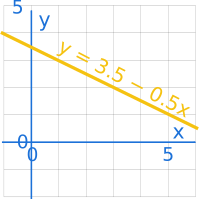
A linear equation is not always in the form y = 3.5 − 0.5x,
It can also be like y = 0.5(7 − x)
Or like y + 0.5x = 3.5
Or like y + 0.5x − 3.5 = 0 and more.
(Note: those are all the same linear equation!)
A System of Linear Equations is when we have two or more linear equations working together.
Let's try to build and solve a real world example:

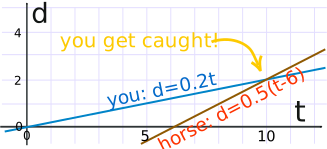
So now you know what a System of Linear Equations is.
Let us continue to find out more about them ....
Solving
There can be many ways to solve linear equations!
Let us see another example:
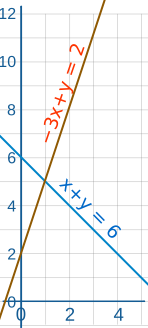
Linear Equations
Only simple variables are allowed in linear equations. No x2, y3, √x, etc:
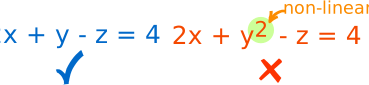
Linear vs non-linear
Dimensions
| A Linear Equation can be in 2 dimensions ... (such as x and y) | 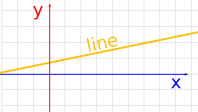 | |
| ... or in 3 dimensions ... (it makes a plane) | 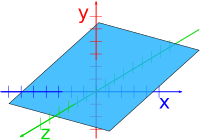 | |
| ... or 4 dimensions ... | ||
| ... or more! |
Common Variables
For the equations to "work together" they share one or more variables:
A System of Equations has two or more equations in one or more variables
Many Variables
So a System of Equations could have many equations and many variables.
There can be any combination:
- 2 equations in 3 variables,
- 6 equations in 4 variables,
- 9,000 equations in 567 variables,
- etc.
Solutions
When the number of equations is the same as the number of variables there is likely to be a solution. Not guaranteed, but likely.
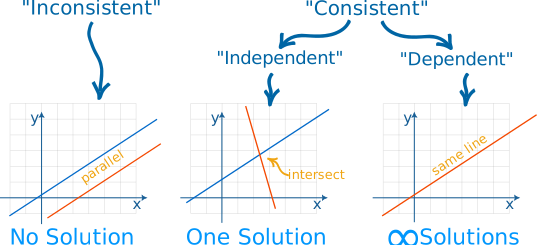
In fact there are only three possible cases:
- No solution
- One solution
- Infinitely many solutions
When there is no solution the equations are called "inconsistent".
One or infinitely many solutions are called "consistent"
Here is a diagram for 2 equations in 2 variables:
Independent
"Independent" means that each equation gives new information.
Otherwise they are "Dependent".
Otherwise they are "Dependent".
Also called "Linear Independence" and "Linear Dependence"
Where the Equations are True
The trick is to find where all equations are true at the same time.
True? What does that mean?
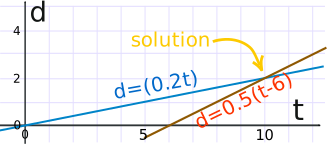
So they have to be true simultaneously ...
... that is why some people call them "Simultaneous Linear Equations"
Solve Using Algebra
It is common to use Algebra to solve them.
Here is the "Horse" example solved using Algebra:
Algebra vs Graphs
Why use Algebra when graphs are so easy? Because:
More than 2 variables can't be solved by a simple graph.
So Algebra comes to the rescue with two popular methods:
- Solving By Substitution
- Solving By Elimination
We will see each one, with examples in 2 variables, and in 3 variables. Here goes ...
Solving By Substitution
These are the steps:
- Write one of the equations so it is in the style "variable = ..."
- Replace (i.e. substitute) that variable in the other equation(s).
- Solve the other equation(s)
- (Repeat as necessary)
Here is an example with 2 equations in 2 variables:
Solving By Substitution: 3 equations in 3 variables
OK! Let's move to a longer example: 3 equations in 3 variables.
This is not hard to do... it just takes a long time!
We can use this method for 4 or more equations and variables... just do the same steps again and again until it is solved.
Conclusion: Substitution works nicely, but does take a long time to do.
Solving By Elimination
Elimination can be faster ... but needs to be kept neat.
"Eliminate" means to remove: this method works by removing variables until there is just one left.
The idea is that we can safely:
- multiply an equation by a constant (except zero),
- add (or subtract) an equation on to another equation
Like in these examples:
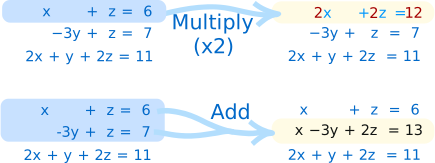
WHY can we add equations to each other?
Imagine two really simple equations:
x − 5 = 3
5 = 5
We can add the "5 = 5" to "x − 5 = 3":5 = 5
x − 5 + 5 = 3 + 5
x = 8
Try that yourself but use 5 = 3+2 as the 2nd equationx = 8
It will still work just fine, because both sides are equal (that is what the = is for!)
We can also swap equations around, so the 1st could become the 2nd, etc, if that helps.
OK, time for a full example. Let's use the 2 equations in 2 variables example from before:
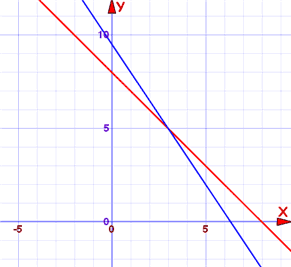
Here is another example:
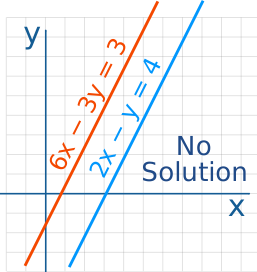
And lastly:
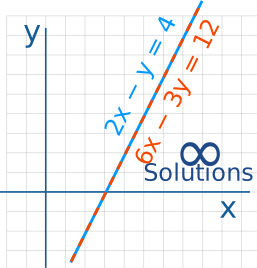
And so now we have seen an example of each of the three possible cases:
- No solution
- One solution
- Infinitely many solutions
Solving By Elimination: 3 equations in 3 variables
Before we start on the next example, let's look at an improved way to do things.
Follow this method and we are less likely to make a mistake.
First of all, eliminate the variables in order:
- Eliminate xs first (from equation 2 and 3, in order)
- then eliminate y (from equation 3)
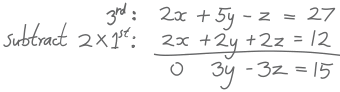
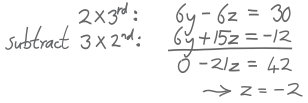
So this is how we eliminate them:
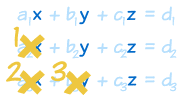
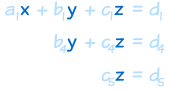
We then have this "triangle shape":
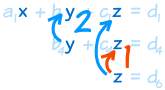
Now start at the bottom and work back up (called "Back-Substitution")
(put in z to find y, then z and y to find x):
(put in z to find y, then z and y to find x):
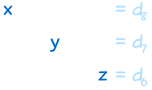
And we are solved:
ALSO, we will find it is easier to do some of the calculations in our head, or on scratch paper, rather than always working within the set of equations:
General Advice
Once you get used to the Elimination Method it becomes easier than Substitution, because you just follow the steps and the answers appear.
But sometimes Substitution can give a quicker result.
- Substitution is often easier for small cases (like 2 equations, or sometimes 3 equations)
- Elimination is easier for larger cases
Week of March 9, 2020 Algebra 1
Greatest Common Factor
The highest number that divides exactly into two or more numbers.
It is the "greatest" thing for simplifying fractions!
It is the "greatest" thing for simplifying fractions!
Let's start with an Example ...
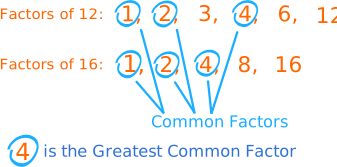
So ... what is a "Factor" ?
Factors are numbers we can multiply together to get another number:
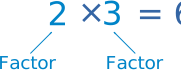
A number can have many factors:
(Read how to find All the Factors of a Number. In our case we don't need the negative ones.)
What is a "Common Factor" ?
Say we have worked out the factors of two numbers:
Then the common factors are those that are found in both lists:
- Notice that 1, 2, 3 and 6 appear in both lists?
- So, the common factors of 12 and 30 are: 1, 2, 3 and 6
It is a common factor when it is a factor of two (or more) numbers.
Here is another example with three numbers:
What is the "Greatest Common Factor" ?
It is simply the largest of the common factors.
In our previous example, the largest of the common factors is 15, so the Greatest Common Factor of 15, 30 and 105 is 15
The "Greatest Common Factor" is the largest of the common factors (of two or more numbers)
Why is this Useful?
One of the most useful things is when we want to simplify a fraction:
Earlier we found that the Common Factors of 12 and 30 are 1, 2, 3 and 6, and so the Greatest Common Factor is 6.
So the largest number we can divide both 12 and 30 exactly by is 6, like this:
| ÷ 6 | ||
 | ||
| 1230 | = | 25 |
 | ||
| ÷ 6 | ||
Finding the Greatest Common Factor
Here are three ways:
1. We can:
- find all factors of both numbers (use the All Factors Calculator),
- then find the ones that are common to both, and
- then choose the greatest.
| Two Numbers | Factors | Common Factors | Greatest Common Factor | Example Simplified Fraction |
|---|---|---|---|---|
| 9 and 12 | 9: 1,3,9 12: 1,2,3,4,6,12 | 1,3 | 3 | 912 = 34 |
And another example:
| Two Numbers | Factors | Common Factors | Greatest Common Factor | Example Simplified Fraction |
|---|---|---|---|---|
| 6 and 18 | 6: 1,2,3,6 18: 1,2,3,6,9,18 | 1,2,3,6 | 6 | 618 = 13 |
2. Or we can find the prime factors and combine the common ones together:
| Two Numbers | Thinking ... | Greatest Common Factor | Example Simplified Fraction |
|---|---|---|---|
| 24 and 108 | 2 × 2 × 2 × 3 = 24, and 2 × 2 × 3 × 3 × 3 = 108 | 2 × 2 × 3 = 12 | 24108 = 29 |
3. Or sometimes we can just play around with the factors until we discover it:
But in that case we must check that we have found the greatest common factor.
| Two Numbers | Thinking ... | Greatest Common Factor | Example Simplified Fraction |
|---|---|---|---|
| 9 and 12 | 3 × 3 = 9 and 3 × 4 = 12 | 3 | 912 = 34 |
Greatest Common Factor Calculator
OK, there is also a really easy method: we can use the Greatest Common Factor Calculator to find it automatically.
Subscribe to:
Posts (Atom)