Monday, February 6, 2017

Week of February 6,2017

Algebra1

Solve systems of equations by graphing

A system of linear equations contains two or more equations e.g. y=0.5x+2 and y=x-2. The solution of such a system is the ordered pair that is a solution to both equations. To solve a system of linear equations graphically we graph both equations in the same coordinate system. The solution to the system will be in the point where the two lines intersect.

Example
{y=2x+2y=x−1

Graph the equations in a coordinate plane
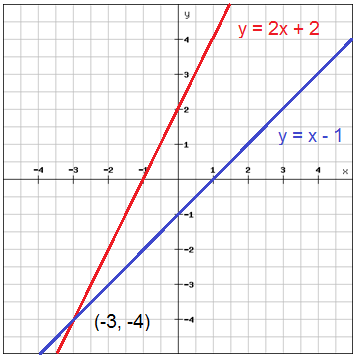
figure30
The two lines intersect in (-3, -4) which is the solution to this system of equations.

Video lesson


http://www.virtualnerd.com/algebra-2/linear-systems/graphing/solve-by-graphing/equations-solution-by-graphing

Algebra 2

Operations on Polynomials


   The definition of a polynomial is not easily explained because it involves several special terms. Knowing these terms is crucial.
TermDefinitionExample in Red
coefficientIt is a constant that is either alone or being multiplied by an expression.3x5 and -7x2y
exponentIt is the power to which a number or expression is being raised.62 and (-2c)3
integerIt is a number that contains no fractional or decimal part.5 and -300
   Now we are ready to understand the definition of a polynomial.
   Definition: A polynomial is an expression composed of coefficients and variables under addition, subtraction and multiplication and exponents on those variables must be non-negative integers.
   This table will help you discern the difference between polynomials and non-polynomials.

ExamplePolynomial or Non-Polynomial
4a3Polynomial
3x-2Non-Polynomial
-5z2/3Non-Polynomial
2x2 + 3x - 5Polynomial


   When adding polynomials, like terms must be combined. For instance, 3c and 5c can be added to get 8c. Likewise, 3x2y and -7x2y can be added to get -4x2y. However, 5x3y and 10x2y5 cannot be added together because they do not have the same exact variables and the exact powers on those variables.   Let those examples guide us regarding the following problem.

(5x^2+6x-3)+(2x^2-7x-9)
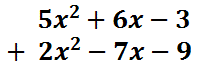
   The best way to handle this is to perform the task vertically, instead of horizontally, while aligning like terms.

(5x^2+6x-3)+(2x^2-7x-9)
   With this arrangement of polynomials, it's easier to determine which terms to combine together.

(5x^2+6x-3)+(2x^2-7x-9)
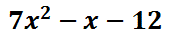
   Consequently, here is the solution.

7x^2-x-12
      ideo: Adding Polynomials
      uiz: Polynomial Addition


   On this next example, care has to be taken.

(-10x^3-4)+(-14x^2+2x-1)
   The reason for care is due to the first polynomial. It is missing an x-squared term and an x-term. This is why place-holder terms must be included.

(-10x^3-4)+(-14x^2+2x-1)
   The vertical placement below emphasizes the correct alignment of like terms to be added.

(-10x^3+0x^2+0x-4)+(0x^2-14x^2+2x-1)
   Consequently, the solution is...

-10x^3-14x^2+2x-5
      ideo: Adding Polynomials
      uiz: Polynomial Addition

   When subtracting numbers, it is possible to change the problem to addition. Here is a case in point.
-4-5
   This problem can be changed to an addition problem. All we have to do is switch the subtraction to addition and then change the second number to its opposite, like this.

-4-5=-4+(-5)
   When problems are converted into addition, they are usually done more successfully. The answer is -9, which is harder to obtain as a subtraction problem. When dealing with polynomial subtraction, we can do the exact same process. Here is an example of a subtraction problem with polynomials.

(3x^2-2x+5)-(-6x^2+7x+4)
   We can also change this problem to addition. Change the subtraction to addition and then switch the last polynomial to its opposite. Our new example would then be…

(3x^2-2x+5)+(6x^2-7x-4)
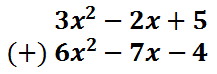
   Notice how the second polynomial changed. The -6 changed to 6. The 7 changed to -7 and the 4 changed to -4. Now, the problem is a polynomial addition problem, which is best accomplished vertically.

(3x^2-2x+5)+(6x^2-7x-4)
   The answer can be gained by adding like terms. The like terms are those that have the same variables and powers on those variables. This vertical form makes it easier to find and add those like terms.

(3x^2-2x+5)+(6x^2-7x-4)
Combining those highlighted like terms gives us the following solution.

9x^2-9x+1
      ideo: Subtracting Polynomials
      uiz: Polynomial Subtraction


   Here is another problem, but this one is in vertical form.

(-7x^2-10x+1)-(12x^2-4x+2)
   We still have to change this problem to addition. We first have to realize it means we are subtracting the bottom polynomial from the top polynomial. So, we have to take the opposite of the second (the bottom) polynomial. This would give us this addition problem.

(-7x^2-10x+1)+(-12x^2+4x-2)
   Notice that the last polynomial, the bottom polynomial, was changed to its opposite. Now, we simply add like terms and the like terms have already been aligned.

(-7x^2-10x+1)+(-12x^2+4x-2)
   After we add like terms, we will get this solution.

-19x^2-6x-1
      ideo: Subtracting Polynomials
      uiz: Polynomial Subtraction

   The best way to multiply polynomials is to do so using a visual organizer. We used a visual organizer in grammar school, called a multiplication table. That is exactly what needs to be used for polynomial multiplication. For example, we will multiply these binomials. [A binomial is a polynomial that has two-terms, bi–nomial.]
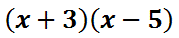
(x+3)(x-5)
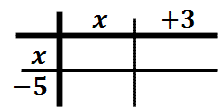
   To do this, we will place the first polynomial on the top of our table and the second on the side of our table. [Some people use the method called “FOIL” instead. However, “FOIL” only works for binomials and is useless for other types of polynomial multiplication problems.]

table
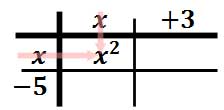
   Now, we will multiply a column times a row. We will multiply “x” times “x” and get x2 and then place that in the table.

table
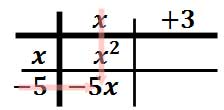
   Likewise, we will multiply “x” times “-5” to get -5x. We will put that in the table.

table
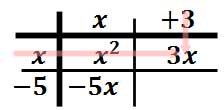
   For our last column, we will begin by multiplying "3" times "x." The result is this.

table
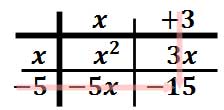
   The last item of the table is gained by multiplying "-5" times "3."

table
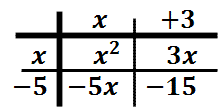
   This leaves us with the following table of elements.

table
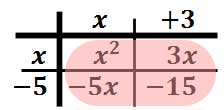
   This process has left us with four terms inside the table.

table
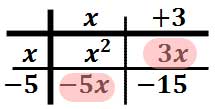
   There are two elements within the table that are like terms and they need to be combined together. These are the two like terms.

table
   If we write out these four elements horizontally, we get this polynomial.

x^2 + 3x - 5x - 15
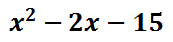
   We need to combine the inner-most terms, which are the like terms. After adding the "3x" and the "-5x," we get this solution.

x^2 - 2x - 15
      ideo: Multiplying Polynomials
      uiz: Polynomial Multiplication


   For our next example, we will look at a much more difficult problem. We will multiply a binomial times a trinomial.

(x+2)(x^2+4x-7)
   Again, we will place these polynomials on the outside of a table. Place the first along the top and the second along the side.

table
   Now, we will begin the process of multiplying columns times rows to gain elements inside the table. Let's start with "x2" times "x" to get "x3."

table
   Multiply "x" times "4x" to get "4x2."

table
   Multiply "x" times "-7" to get "-7x."

table
   Multiply "2" times "x2" to get "2x2."

table
   Multiply "2" times "4x" to get "8x."

table
   Multiply "2" times "-7" to get the final element in the table, which is "-14."

table
   Alright. We have a completed table! We are almost done.

table
   Notice there are six elements within our table. These elements will be used to gain our solution.

table
   The six elements will be simplified to produce the solution. Notice, however, there are like terms that need to be combined. These like terms have like powers and have been color-coded below.

table
   Taking the elements of the table out and writing them horizontally, we get this unsimplified polynomial. Like terms have been color-coded.

x^3+2x^2+4x^2+8x-7x-14
   We will combine the like terms by adding "2" with "4" and then adding "8" with "-7." This is the solution.

x^3+2x^2+4x^2+8x-7x-14

Monday, January 30, 2017

Week of January 30,2017

ALGEBRA 1

Solve Inequalities
How do you solve a linear inequality and sketch the solution on a number line?
How do you solve an absolute value inequality and sketch the solution on a number line?
Investigation
Graphic Organizer
Notes
Practice
Application/Extension
Online Extra Practice
Textbook Video Tutorials
Regents Prep Text Tutorials
OtherTutorials

carlisleschools.org
ALGEBBRA 2 

Operations on Complex Numbers

Complex numbers are "binomials" of a sort, and are added, subtracted, and multiplied in a similar way. (Division, which is further down the page, is a bit different.) First, though, you'll probably be asked to demonstrate that you understand the definition of complex numbers.
  • Solve 3 – 4i = x + yi
  • Finding the answer to this involves nothing more than knowing that two complex numbers can be equal only if their real and imaginary parts are equal. In other words, 3 = x and –4 = y.
To simplify complex-valued expressions, you combine "like" terms and apply the various other methods you learned for working with polynomials.
  • Simplify (2 + 3i) + (1 – 6i).
    (2 + 3i) + (1 – 6i) = (2 + 1) + (3i – 6i) = 3 + (–3i) = 3 – 3i
  • Simplify (5 – 2i) – (–4 – i).
    (5 – 2i) – (–4 – i)
      = (5 – 2i) – 1(–4 – i) = 5 – 2i – 1(–4) – 1(–i)
      = 5 – 2i + 4 + i= (5 + 4) + (–2i + i)
      = (9) + (–1i) = 9 – i
You may find it helpful to insert the "1" in front of the second set of parentheses (highlighted in red above) so you can better keep track of the "minus" being multiplied through the parentheses.
  • Simplify (2 – i)(3 + 4i).
For the last example above, FOILing works for this kind of multiplication, if you learned that method. But whatever method you use, remember that multiplying and adding with complexes works just like multiplying and adding polynomials, except that, while x2 is just x2, i2 is –1. You can use the exact same techniques for simplifying complex-number expressions as you do for polynomial expressions, but you can simplify even further with complexes because i2 reduces to the number –1.

Adding and multiplying complexes isn't too bad. It's when you work with fractions (that is, with division) that things turn ugly. Most of the reason for this ugliness is actually arbitrary. Remember back in elementary school, when you first learned fractions? Your teacher would get her panties in a wad if you used "improper" fractions. For instance, you couldn't say " 3/2 "; you had to convert it to "1 1/2". But now that you're in algebra, nobody cares, and you've probably noticed that "improper" fractions are often more useful than "mixed" numbers. The issue with complex numbers is that your professor will get his boxers in a bunch if you leave imaginaries in the denominator. So how do you handle this?
Suppose you have the following exercise:   Copyright © Elizabeth Stapel 2000-2011 All Rights Reserved
  • Simplify  3/(2i)
    This is pretty "simple", but they want me to get rid of that i underneath, in the denominator. The 2in the denominator is fine, but the i has got to go. To do this, I will use the fact that i2 = –1. If I multiply the fraction, top and bottom, by i, then the i underneath will vanish in a puff of negativity:
      3/2i = –(3/2)i
    So the answer is -(3/2)i
This was simple enough, but what if they give you something more complicated?
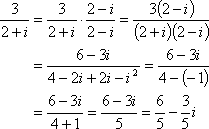
  • Simplify 3/(2 + i)
    If I multiply this fraction, top and bottom, by i, I'll get:
      3/(2 + i) = 3i/(-1 + 2i)
    Since I still have an i underneath, this didn't help much. So how do I handle this simplification? I use something called "conjugates". The conjugate of a complex number a + bi is the same number, but with the opposite sign in the middle: a – bi. When you multiply conjugates, you are, in effect, multiplying to create something in the pattern of a difference of squares:
      (a + bi)(a - bi) = a^2 + b^2
    Note that the i's disappeared, and the final result was a sum of squares. This is what the conjugate is for, and here's how it is used:
      3/(2 + i) = (6/5) - (3/5)i
    So the answer is (6/5) - (3/5)i
In the last step, note how the fraction was split into two pieces. This is because, technically speaking, a complex number is in two parts, the real part and the i part. They aren't supposed to "share" the denominator. To be sure your answer is completely correct, split the complex-valued fraction into its two separate terms.

purplemath.com